Deprecated: WPML_Translations::__construct(): Implicitly marking parameter $wpml_cache as nullable is deprecated, the explicit nullable type must be used instead in /home/clearsou/mynextcompany.eu/wp-content/plugins/sitepress-multilingual-cms/classes/translations/class-wpml-translations.php on line 26
https://mynextcompany.eu/how-can-employer-branding-help-you-attract-the-right-talent/
Deprecated: Using null as an array offset is deprecated, use an empty string instead in /home/clearsou/mynextcompany.eu/wp-includes/class-wp-block-type-registry.php on line 168
Deprecated: Using null as the key parameter for array_key_exists() is deprecated, use an empty string instead in /home/clearsou/mynextcompany.eu/wp-content/plugins/sitepress-multilingual-cms/vendor/wpml/fp/core/Obj.php on line 98
Deprecated: Using null as an array offset is deprecated, use an empty string instead in /home/clearsou/mynextcompany.eu/wp-includes/class-wp-block-type-registry.php on line 168
Deprecated: Using null as an array offset is deprecated, use an empty string instead in /home/clearsou/mynextcompany.eu/wp-includes/class-wp-block-type-registry.php on line 168
Deprecated: Using null as an array offset is deprecated, use an empty string instead in /home/clearsou/mynextcompany.eu/wp-includes/class-wp-block-type-registry.php on line 168
Deprecated: Using null as an array offset is deprecated, use an empty string instead in /home/clearsou/mynextcompany.eu/wp-includes/class-wp-block-type-registry.php on line 168
Deprecated: Using ${var} in strings is deprecated, use {$var} instead in /home/clearsou/mynextcompany.eu/wp-content/themes/Divi/includes/builder/module/settings/migration/ColumnOptions.php on line 95
Deprecated: Using ${var} in strings is deprecated, use {$var} instead in /home/clearsou/mynextcompany.eu/wp-content/themes/Divi/includes/builder/module/settings/migration/ColumnOptions.php on line 95
Deprecated: Using ${var} in strings is deprecated, use {$var} instead in /home/clearsou/mynextcompany.eu/wp-content/themes/Divi/includes/builder/module/settings/migration/ColumnOptions.php on line 97
Deprecated: Using ${var} in strings is deprecated, use {$var} instead in /home/clearsou/mynextcompany.eu/wp-content/themes/Divi/includes/builder/module/settings/migration/ColumnOptions.php on line 97
Deprecated: Using ${var} in strings is deprecated, use {$var} instead in /home/clearsou/mynextcompany.eu/wp-content/themes/Divi/includes/builder/module/settings/migration/ColumnOptions.php on line 103
Deprecated: Using ${var} in strings is deprecated, use {$var} instead in /home/clearsou/mynextcompany.eu/wp-content/themes/Divi/includes/builder/module/settings/migration/ColumnOptions.php on line 103
Deprecated: Using ${var} in strings is deprecated, use {$var} instead in /home/clearsou/mynextcompany.eu/wp-content/themes/Divi/includes/builder/module/settings/migration/ColumnOptions.php on line 105
Deprecated: Using ${var} in strings is deprecated, use {$var} instead in /home/clearsou/mynextcompany.eu/wp-content/themes/Divi/includes/builder/module/settings/migration/ColumnOptions.php on line 105
Deprecated: Using ${var} in strings is deprecated, use {$var} instead in /home/clearsou/mynextcompany.eu/wp-content/themes/Divi/includes/builder/module/settings/migration/ColumnOptions.php on line 130
Deprecated: Using ${var} in strings is deprecated, use {$var} instead in /home/clearsou/mynextcompany.eu/wp-content/themes/Divi/includes/builder/module/settings/migration/ColumnOptions.php on line 130
Deprecated: Using ${var} in strings is deprecated, use {$var} instead in /home/clearsou/mynextcompany.eu/wp-content/themes/Divi/includes/builder/module/settings/migration/ColumnOptions.php on line 132
Deprecated: Using ${var} in strings is deprecated, use {$var} instead in /home/clearsou/mynextcompany.eu/wp-content/themes/Divi/includes/builder/module/settings/migration/ColumnOptions.php on line 132
Deprecated: Using ${var} in strings is deprecated, use {$var} instead in /home/clearsou/mynextcompany.eu/wp-content/themes/Divi/includes/builder/module/settings/migration/ColumnOptions.php on line 161
Deprecated: Using ${var} in strings is deprecated, use {$var} instead in /home/clearsou/mynextcompany.eu/wp-content/themes/Divi/includes/builder/module/settings/migration/ColumnOptions.php on line 161
Deprecated: Using ${var} in strings is deprecated, use {$var} instead in /home/clearsou/mynextcompany.eu/wp-content/themes/Divi/includes/builder/module/settings/migration/ColumnOptions.php on line 161
Deprecated: Using ${var} in strings is deprecated, use {$var} instead in /home/clearsou/mynextcompany.eu/wp-content/themes/Divi/includes/builder/module/settings/migration/ColumnOptions.php on line 162
Deprecated: Using ${var} in strings is deprecated, use {$var} instead in /home/clearsou/mynextcompany.eu/wp-content/themes/Divi/includes/builder/module/settings/migration/ColumnOptions.php on line 162
Deprecated: Using ${var} in strings is deprecated, use {$var} instead in /home/clearsou/mynextcompany.eu/wp-content/themes/Divi/includes/builder/module/settings/migration/ColumnOptions.php on line 162
Deprecated: Using ${var} in strings is deprecated, use {$var} instead in /home/clearsou/mynextcompany.eu/wp-content/themes/Divi/includes/builder/module/settings/migration/ColumnOptions.php on line 205
Deprecated: Using ${var} in strings is deprecated, use {$var} instead in /home/clearsou/mynextcompany.eu/wp-content/themes/Divi/includes/builder/module/settings/migration/ColumnOptions.php on line 205
Deprecated: Using ${var} in strings is deprecated, use {$var} instead in /home/clearsou/mynextcompany.eu/wp-content/themes/Divi/includes/builder/module/settings/migration/ColumnOptions.php on line 205
Deprecated: Using ${var} in strings is deprecated, use {$var} instead in /home/clearsou/mynextcompany.eu/wp-content/themes/Divi/includes/builder/module/settings/migration/ColumnOptions.php on line 205
Deprecated: Using ${var} in strings is deprecated, use {$var} instead in /home/clearsou/mynextcompany.eu/wp-content/themes/Divi/includes/builder/module/settings/migration/ColumnOptions.php on line 207
Deprecated: Using ${var} in strings is deprecated, use {$var} instead in /home/clearsou/mynextcompany.eu/wp-content/themes/Divi/includes/builder/module/settings/migration/ColumnOptions.php on line 207
Deprecated: Using ${var} in strings is deprecated, use {$var} instead in /home/clearsou/mynextcompany.eu/wp-content/themes/Divi/includes/builder/module/settings/migration/ColumnOptions.php on line 207
Deprecated: Creation of dynamic property ET_Builder_Section::$_original_content is deprecated in /home/clearsou/mynextcompany.eu/wp-content/themes/Divi/includes/builder/class-et-builder-element.php on line 1315
Deprecated: Creation of dynamic property ET_Builder_Module_Field_Border::$template is deprecated in /home/clearsou/mynextcompany.eu/wp-content/themes/Divi/includes/builder/module/field/Border.php on line 48
Deprecated: Using ${var} in strings is deprecated, use {$var} instead in /home/clearsou/mynextcompany.eu/wp-content/themes/Divi/includes/builder/module/field/Position.php on line 198
Deprecated: Using ${var} in strings is deprecated, use {$var} instead in /home/clearsou/mynextcompany.eu/wp-content/themes/Divi/includes/builder/module/field/Position.php on line 199
Deprecated: Using ${var} in strings is deprecated, use {$var} instead in /home/clearsou/mynextcompany.eu/wp-content/themes/Divi/includes/builder/module/field/Position.php on line 200
Deprecated: Using ${var} in strings is deprecated, use {$var} instead in /home/clearsou/mynextcompany.eu/wp-content/themes/Divi/includes/builder/module/field/Position.php on line 500
Deprecated: Using ${var} in strings is deprecated, use {$var} instead in /home/clearsou/mynextcompany.eu/wp-content/themes/Divi/includes/builder/module/field/Position.php on line 583
Deprecated: Using ${var} in strings is deprecated, use {$var} instead in /home/clearsou/mynextcompany.eu/wp-content/themes/Divi/includes/builder/module/field/Transform.php on line 79
Deprecated: Using ${var} in strings is deprecated, use {$var} instead in /home/clearsou/mynextcompany.eu/wp-content/themes/Divi/includes/builder/module/field/Transform.php on line 79
Deprecated: Using ${var} in strings is deprecated, use {$var} instead in /home/clearsou/mynextcompany.eu/wp-content/themes/Divi/includes/builder/module/field/Transform.php on line 98
Deprecated: Using ${var} in strings is deprecated, use {$var} instead in /home/clearsou/mynextcompany.eu/wp-content/themes/Divi/includes/builder/module/field/Transform.php on line 98
Deprecated: Using ${var} in strings is deprecated, use {$var} instead in /home/clearsou/mynextcompany.eu/wp-content/themes/Divi/includes/builder/module/field/Transform.php on line 117
Deprecated: Using ${var} in strings is deprecated, use {$var} instead in /home/clearsou/mynextcompany.eu/wp-content/themes/Divi/includes/builder/module/field/Transform.php on line 117
Deprecated: Using ${var} in strings is deprecated, use {$var} instead in /home/clearsou/mynextcompany.eu/wp-content/themes/Divi/includes/builder/module/field/Transform.php on line 117
Deprecated: Using ${var} in strings is deprecated, use {$var} instead in /home/clearsou/mynextcompany.eu/wp-content/themes/Divi/includes/builder/module/field/Transform.php on line 136
Deprecated: Using ${var} in strings is deprecated, use {$var} instead in /home/clearsou/mynextcompany.eu/wp-content/themes/Divi/includes/builder/module/field/Transform.php on line 136
Deprecated: Using ${var} in strings is deprecated, use {$var} instead in /home/clearsou/mynextcompany.eu/wp-content/themes/Divi/includes/builder/module/field/Transform.php on line 157
Deprecated: Using ${var} in strings is deprecated, use {$var} instead in /home/clearsou/mynextcompany.eu/wp-content/themes/Divi/includes/builder/module/field/Transform.php on line 157
Deprecated: Using ${var} in strings is deprecated, use {$var} instead in /home/clearsou/mynextcompany.eu/wp-content/themes/Divi/includes/builder/module/field/Transform.php on line 199
Deprecated: Using ${var} in strings is deprecated, use {$var} instead in /home/clearsou/mynextcompany.eu/wp-content/themes/Divi/includes/builder/module/field/Transform.php on line 200
Deprecated: Using ${var} in strings is deprecated, use {$var} instead in /home/clearsou/mynextcompany.eu/wp-content/themes/Divi/includes/builder/module/field/Transform.php on line 201
Deprecated: Using ${var} in strings is deprecated, use {$var} instead in /home/clearsou/mynextcompany.eu/wp-content/themes/Divi/includes/builder/module/field/Transform.php on line 203
Deprecated: Using ${var} in strings is deprecated, use {$var} instead in /home/clearsou/mynextcompany.eu/wp-content/themes/Divi/includes/builder/module/field/Transform.php on line 204
Deprecated: Using ${var} in strings is deprecated, use {$var} instead in /home/clearsou/mynextcompany.eu/wp-content/themes/Divi/includes/builder/module/field/Transform.php on line 205
Deprecated: Using ${var} in strings is deprecated, use {$var} instead in /home/clearsou/mynextcompany.eu/wp-content/themes/Divi/includes/builder/module/field/Transform.php on line 206
Deprecated: Using ${var} in strings is deprecated, use {$var} instead in /home/clearsou/mynextcompany.eu/wp-content/themes/Divi/includes/builder/module/field/Transform.php on line 207
Deprecated: Using ${var} in strings is deprecated, use {$var} instead in /home/clearsou/mynextcompany.eu/wp-content/themes/Divi/includes/builder/module/field/Transform.php on line 364
Deprecated: Using ${var} in strings is deprecated, use {$var} instead in /home/clearsou/mynextcompany.eu/wp-content/themes/Divi/includes/builder/module/field/Transform.php on line 364
Deprecated: Using ${var} in strings is deprecated, use {$var} instead in /home/clearsou/mynextcompany.eu/wp-content/themes/Divi/includes/builder/module/field/Transform.php on line 565
Deprecated: Creation of dynamic property ET_Builder_Module_Helper_MultiViewOptions::$inherited_props is deprecated in /home/clearsou/mynextcompany.eu/wp-content/themes/Divi/includes/builder/module/helpers/MultiViewOptions.php on line 686
Deprecated: Creation of dynamic property ET_Builder_Module_Field_Divider::$count is deprecated in /home/clearsou/mynextcompany.eu/wp-content/themes/Divi/includes/builder/main-structure-elements.php on line 1498
Deprecated: Creation of dynamic property ET_Builder_Row::$_original_content is deprecated in /home/clearsou/mynextcompany.eu/wp-content/themes/Divi/includes/builder/class-et-builder-element.php on line 1315
Deprecated: Creation of dynamic property ET_Builder_Column::$_original_content is deprecated in /home/clearsou/mynextcompany.eu/wp-content/themes/Divi/includes/builder/class-et-builder-element.php on line 1315
Deprecated: Creation of dynamic property ET_Builder_Module_Image::$text_shadow is deprecated in /home/clearsou/mynextcompany.eu/wp-content/themes/Divi/includes/builder/class-et-builder-element.php on line 1315
Deprecated: Creation of dynamic property ET_Builder_Module_Image::$margin_padding is deprecated in /home/clearsou/mynextcompany.eu/wp-content/themes/Divi/includes/builder/class-et-builder-element.php on line 1315
Deprecated: Creation of dynamic property ET_Builder_Module_Image::$_additional_fields_options is deprecated in /home/clearsou/mynextcompany.eu/wp-content/themes/Divi/includes/builder/class-et-builder-element.php on line 1315
Deprecated: Creation of dynamic property ET_Builder_Module_Image::$_original_content is deprecated in /home/clearsou/mynextcompany.eu/wp-content/themes/Divi/includes/builder/class-et-builder-element.php on line 1315
Deprecated: Creation of dynamic property ET_Builder_Module_Helper_MultiViewOptions::$inherited_props is deprecated in /home/clearsou/mynextcompany.eu/wp-content/themes/Divi/includes/builder/module/helpers/MultiViewOptions.php on line 686
Deprecated: Creation of dynamic property ET_Builder_Module_Text::$text_shadow is deprecated in /home/clearsou/mynextcompany.eu/wp-content/themes/Divi/includes/builder/class-et-builder-element.php on line 1315
Deprecated: Creation of dynamic property ET_Builder_Module_Text::$margin_padding is deprecated in /home/clearsou/mynextcompany.eu/wp-content/themes/Divi/includes/builder/class-et-builder-element.php on line 1315
Deprecated: Creation of dynamic property ET_Builder_Module_Text::$_additional_fields_options is deprecated in /home/clearsou/mynextcompany.eu/wp-content/themes/Divi/includes/builder/class-et-builder-element.php on line 1315
Deprecated: Creation of dynamic property ET_Builder_Module_Text::$_original_content is deprecated in /home/clearsou/mynextcompany.eu/wp-content/themes/Divi/includes/builder/class-et-builder-element.php on line 1315
Deprecated: Creation of dynamic property ET_Builder_Module_Helper_MultiViewOptions::$inherited_props is deprecated in /home/clearsou/mynextcompany.eu/wp-content/themes/Divi/includes/builder/module/helpers/MultiViewOptions.php on line 686

Recruitment turned a corner in the early 2000s with the arrival of social and professional networks (creation of LinkedIn in 2003). The search for new talent is now easier and makes it possible to connect companies and candidates more quickly.
The talent war
In 2019, however, the competition between companies to find the best talent is becoming increasingly fierce. Candidates with “rarer” skills, such as developers, are highly sought-after and even harassed. As a result, most of them decide to hide and are almost inaccessible.
Employer branding as a solution
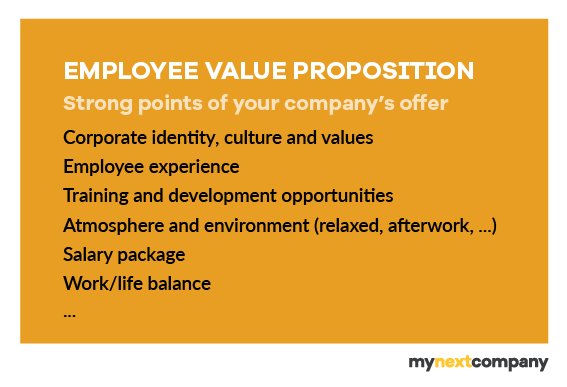
Traditional recruitment is therefore no longer sufficient to find these rare talents. So what’s the solution? One approach that has already proved its worth is to create an employer branding strategy in order to attract the right candidates by highlighting the many, often underestimated advantages your company offers (jointly named Employee Value Proposition), such as:
- Corporate identity, culture and values
- Employee experience
- Training and development opportunities
- Atmosphere and environment (relaxed, afterwork, …)
- Salary package
- Work/life balance
Why implement this strategy?
By showcasing these different aspects of your company, you will build a strong and authentic brand image.
Thanks to your employer branding, future employees will have a clear vision of what your company is really like.
Moreover, companies that invest in an employer branding strategy have more motivated and effective employees, who then become real ambassadors for the company.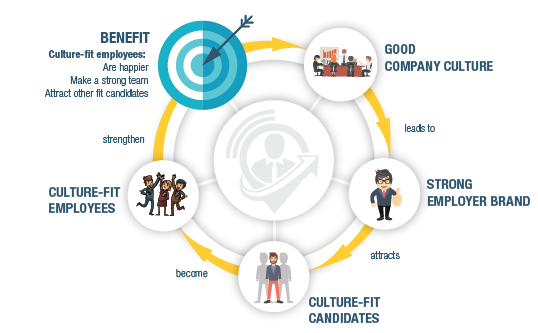
Conclusion
Employer branding is a virtuous circle. Working on your corporate culture and investing in your employees’ wellbeing will enable you to obtain a strong employer brand. This in turn will attract and strengthen your company culture. You will reap many benefits, such as happy and committed employees who will position themselves as ambassadors for your brand and in turn attract other candidates of the same calibre.
It’s therefore clear that traditional recruitment is no longer sufficient. This is why the Smart Recruiting ® method was created. It combines employer branding and inbound recruitment for fast, efficient and qualitative recruitment. Download our free ebook below to discover how to find and retain the talent you need!
The post How Can Employer Branding Help You Attract the right Talent appeared first on MyNextCompany.
]]>Deprecated: Using null as an array offset is deprecated, use an empty string instead in /home/clearsou/mynextcompany.eu/wp-includes/class-wp-block-type-registry.php on line 168
Deprecated: Using null as the key parameter for array_key_exists() is deprecated, use an empty string instead in /home/clearsou/mynextcompany.eu/wp-content/plugins/sitepress-multilingual-cms/vendor/wpml/fp/core/Obj.php on line 98
Deprecated: Using null as an array offset is deprecated, use an empty string instead in /home/clearsou/mynextcompany.eu/wp-includes/class-wp-block-type-registry.php on line 168
Deprecated: Using null as an array offset is deprecated, use an empty string instead in /home/clearsou/mynextcompany.eu/wp-includes/class-wp-block-type-registry.php on line 168
Deprecated: Using null as an array offset is deprecated, use an empty string instead in /home/clearsou/mynextcompany.eu/wp-includes/class-wp-block-type-registry.php on line 168
Deprecated: Using null as an array offset is deprecated, use an empty string instead in /home/clearsou/mynextcompany.eu/wp-includes/class-wp-block-type-registry.php on line 168
Deprecated: Creation of dynamic property ET_Builder_Module_Helper_MultiViewOptions::$inherited_props is deprecated in /home/clearsou/mynextcompany.eu/wp-content/themes/Divi/includes/builder/module/helpers/MultiViewOptions.php on line 686
Deprecated: Creation of dynamic property ET_Builder_Module_Helper_MultiViewOptions::$inherited_props is deprecated in /home/clearsou/mynextcompany.eu/wp-content/themes/Divi/includes/builder/module/helpers/MultiViewOptions.php on line 686
Deprecated: Creation of dynamic property ET_Builder_Module_Helper_MultiViewOptions::$inherited_props is deprecated in /home/clearsou/mynextcompany.eu/wp-content/themes/Divi/includes/builder/module/helpers/MultiViewOptions.php on line 686

Growing your business significantly brings both excitement and pressure. Of course, being able to grow your business means it is successful. You might be about to scale up a booming startup, or perhaps you’re an executive in a well established company that’s looking to branch out to new challenges and projects.

When expanding your business, it’s vital to recruit people with the right skills and personality. There are many circumstances to consider, and often opportunities are time-sensitive, which means that you need to increase your headcount quickly. However, growing your workforce in the right way is key to the continued success of your business.
What is the best way to prepare your business to meet the needs and challenges that expansion brings?
Let’s take a look at the three key points.
Identifying your recruitment needs
First of all, know exactly what you need in order to be able to get it.
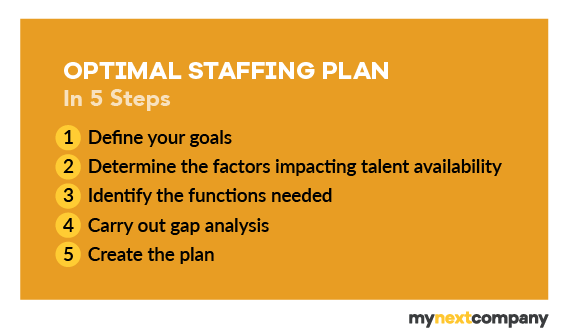
Make sure to allocate sufficient time to building your staffing plan. From identifying your organisation’s goals and function needs to assessing the skill sets you currently have and those ones you’re missing, creating a staffing plan is critical to ensuring you get the right people onboard. Follow these steps to start working on your staffing plan.
- Define your goals
- Determine the factors impacting talent availability
- Identify the functions needed
- Carry out gap analysis
- Create the plan
Choosing a recruitment agency you can trust
People can make or break your business. To quote Larry Bossidy, a businessman who spent three decades rising through the executive positions at General Electric before becoming a CEO at Honeywell,
“At the end of the day you bet on people, not on strategies.”
It’s therefore crucial to find a trusted partner for your recruitment needs. What you need is an agency that makes the effort to get to know your company so they can understand your business, and one that stays up to date with the newest trends and technologies so they can offer you the smartest, most efficient ways of working.
It’s essential to trust your agency in order to make them a true partner in your quest to hire people who will help your business flourish. It’s also important to be able to share your long-term goals with your agency.
Sharing your staffing plan with your agency
A study from the Harvard Business Review suggests that companies should disclose more actionable information around competitive positioning, corporate purpose and strategic partnerships as a resource for companies, investors and researchers. The study shows that companies that do so have significantly larger market reactions than those that don’t.
In the right hands, transparency regarding your recruitment goals helps the agency to plan around your future hiring needs. Technological developments offer recruiters an array of tools to reach the right candidates for you.
This is especially important when it comes to professions that are in high demand, such as IT or engineering roles. Rather than fishing in the same small pond, some recruitment companies use digital tools to attract candidates and help them shift from passive (not actively looking for a job, but potentially interested in new opportunities) to active. This process takes time, however, so it’s vital to contact a recruitment agency at an early stage.
Conclusion
It is therefore clear that the key to successful business growth lies in recruitment. Once you have a staffing plan in place, you’ve made the first step towards attracting the talent you seek. Select the right recruitment agency for your company and share your staffing plan and goals with them, and you will soon reap the benefits of business growth long into the future of your company.
Discover Smart Recruiting®, a method that combines digital tools and marketing strategy for fast, efficient, and qualitative recruitment. Click on the button below for more information.
The post The Best Strategy for Intense Workforce Growth appeared first on MyNextCompany.
]]>Deprecated: Using null as an array offset is deprecated, use an empty string instead in /home/clearsou/mynextcompany.eu/wp-includes/class-wp-block-type-registry.php on line 168
Deprecated: Using null as the key parameter for array_key_exists() is deprecated, use an empty string instead in /home/clearsou/mynextcompany.eu/wp-content/plugins/sitepress-multilingual-cms/vendor/wpml/fp/core/Obj.php on line 98
Deprecated: Using null as an array offset is deprecated, use an empty string instead in /home/clearsou/mynextcompany.eu/wp-includes/class-wp-block-type-registry.php on line 168
Deprecated: Using null as an array offset is deprecated, use an empty string instead in /home/clearsou/mynextcompany.eu/wp-includes/class-wp-block-type-registry.php on line 168
Deprecated: Using null as an array offset is deprecated, use an empty string instead in /home/clearsou/mynextcompany.eu/wp-includes/class-wp-block-type-registry.php on line 168
Deprecated: Using null as an array offset is deprecated, use an empty string instead in /home/clearsou/mynextcompany.eu/wp-includes/class-wp-block-type-registry.php on line 168
Deprecated: Creation of dynamic property ET_Builder_Module_Helper_MultiViewOptions::$inherited_props is deprecated in /home/clearsou/mynextcompany.eu/wp-content/themes/Divi/includes/builder/module/helpers/MultiViewOptions.php on line 686
Deprecated: Creation of dynamic property ET_Builder_Module_Helper_MultiViewOptions::$inherited_props is deprecated in /home/clearsou/mynextcompany.eu/wp-content/themes/Divi/includes/builder/module/helpers/MultiViewOptions.php on line 686
Deprecated: Creation of dynamic property ET_Builder_Module_Helper_MultiViewOptions::$inherited_props is deprecated in /home/clearsou/mynextcompany.eu/wp-content/themes/Divi/includes/builder/module/helpers/MultiViewOptions.php on line 686

Finding the right person with the right hard skills can be very complex. Due to the raging talent war, many managers decide to compromise by putting soft skills aside. However, soft skills or culture-fit should never be sacrificed in favour of hard skills.
Are hard skills outdated?
It is currently difficult to recruit talent, and this is only expected to increase. Indeed, according to a report by Dell and the Institute for the Future,
85% of the jobs that will exist in 2030 do not exist yet.
It is therefore more appropriate to capitalise on soft skills. Indeed, even if a candidate does not tick all the boxes necessary to do a job but is agile and has the ability to adapt or solve problems, you can more easily train them, make them evolve and equip them with more technical skills. This is especially true in the current climate where new tools, technologies and work systems are emerging at a frenetic pace and need to be constantly updated. The real challenge is to find someone who has the potential to acquire these skills in the medium to short term.
Culture-fit
Finding the talent that fits your environment will also bring great value to your company and have a positive impact on your bottom line. Employees who integrate well into a team are happier and, as Laurence Vanhée explains,
“Being happier at work improves performance”.
Dissatisfaction and stress push people to change job more frequently. This can lead to an increase of almost 50% in turnover. This issue needs to be monitored closely in the current context of talent shortages. Finally, a good atmosphere and culture in a company attracts candidates who are compatible with the business and creates a virtuous circle.
Consequences of failed recruitment
Hiring someone who doesn’t fit your business will cost you money and waste valuable time. The recruitment process is already expensive, but laying off an employee and finding someone else is even more so. Unfortunately, this aspect is underestimated far too often.
To learn more about the real costs of failed recruitment, read our article The Real Cost of Not Finding the Right Talent.
Smaller structures
In a start-up or scale-up, soft skills and cultural compatibility are essential and relegate hard skills to the background.
For example, if a company hires an expert on a certain technology with 10 years’ experience and whose habits are already well established, how will they adapt in the event of change (which is very frequent in this type of company) or a new technology? They will certainly not be as flexible as a less experienced candidate, but one who has potential and jumps at the opportunity to train within a growing company.
Conclusion
It is vital to focus not only on hard skills. Instead, focus your energy on hiring candidates with the right DNA for your company and the ability to grow within it. Invest time in training the right people and the results will be even more positive.
But how do you attract the right candidates that will fit your corporate culture? Discover the Smart Recruiting® method, which combines Employer Branding, digital tools and marketing strategy for a targeted and qualitative recruitment. Click on the link below to learn more!
The post Soft Skills Are the New Hard Skills appeared first on MyNextCompany.
]]>Deprecated: Using null as the key parameter for array_key_exists() is deprecated, use an empty string instead in /home/clearsou/mynextcompany.eu/wp-content/plugins/sitepress-multilingual-cms/vendor/wpml/fp/core/Obj.php on line 98
Deprecated: Using null as an array offset is deprecated, use an empty string instead in /home/clearsou/mynextcompany.eu/wp-includes/class-wp-block-type-registry.php on line 168
Deprecated: Using null as an array offset is deprecated, use an empty string instead in /home/clearsou/mynextcompany.eu/wp-includes/class-wp-block-type-registry.php on line 168
Deprecated: Using null as an array offset is deprecated, use an empty string instead in /home/clearsou/mynextcompany.eu/wp-includes/class-wp-block-type-registry.php on line 168
Deprecated: Using null as an array offset is deprecated, use an empty string instead in /home/clearsou/mynextcompany.eu/wp-includes/class-wp-block-type-registry.php on line 168
Deprecated: Using null as an array offset is deprecated, use an empty string instead in /home/clearsou/mynextcompany.eu/wp-includes/class-wp-block-type-registry.php on line 168
Deprecated: Using null as the key parameter for array_key_exists() is deprecated, use an empty string instead in /home/clearsou/mynextcompany.eu/wp-content/plugins/sitepress-multilingual-cms/vendor/wpml/fp/core/Obj.php on line 98
Deprecated: Using null as an array offset is deprecated, use an empty string instead in /home/clearsou/mynextcompany.eu/wp-includes/class-wp-block-type-registry.php on line 168
Deprecated: Using null as an array offset is deprecated, use an empty string instead in /home/clearsou/mynextcompany.eu/wp-includes/class-wp-block-type-registry.php on line 168
Deprecated: Using null as an array offset is deprecated, use an empty string instead in /home/clearsou/mynextcompany.eu/wp-includes/class-wp-block-type-registry.php on line 168
Deprecated: Using null as an array offset is deprecated, use an empty string instead in /home/clearsou/mynextcompany.eu/wp-includes/class-wp-block-type-registry.php on line 168
The post What Happens When You Can’t Find Talent appeared first on MyNextCompany.
]]>Deprecated: Using null as an array offset is deprecated, use an empty string instead in /home/clearsou/mynextcompany.eu/wp-includes/class-wp-block-type-registry.php on line 168
Deprecated: Using null as the key parameter for array_key_exists() is deprecated, use an empty string instead in /home/clearsou/mynextcompany.eu/wp-content/plugins/sitepress-multilingual-cms/vendor/wpml/fp/core/Obj.php on line 98
Deprecated: Using null as an array offset is deprecated, use an empty string instead in /home/clearsou/mynextcompany.eu/wp-includes/class-wp-block-type-registry.php on line 168
Deprecated: Using null as an array offset is deprecated, use an empty string instead in /home/clearsou/mynextcompany.eu/wp-includes/class-wp-block-type-registry.php on line 168
Deprecated: Using null as an array offset is deprecated, use an empty string instead in /home/clearsou/mynextcompany.eu/wp-includes/class-wp-block-type-registry.php on line 168
Deprecated: Using null as an array offset is deprecated, use an empty string instead in /home/clearsou/mynextcompany.eu/wp-includes/class-wp-block-type-registry.php on line 168
Deprecated: Creation of dynamic property ET_Builder_Module_Helper_MultiViewOptions::$inherited_props is deprecated in /home/clearsou/mynextcompany.eu/wp-content/themes/Divi/includes/builder/module/helpers/MultiViewOptions.php on line 686
Deprecated: Creation of dynamic property ET_Builder_Module_Helper_MultiViewOptions::$inherited_props is deprecated in /home/clearsou/mynextcompany.eu/wp-content/themes/Divi/includes/builder/module/helpers/MultiViewOptions.php on line 686
Deprecated: Creation of dynamic property ET_Builder_Module_Helper_MultiViewOptions::$inherited_props is deprecated in /home/clearsou/mynextcompany.eu/wp-content/themes/Divi/includes/builder/module/helpers/MultiViewOptions.php on line 686

Recruitment has changed significantly in recent years, and the classical approach to recruitment is no longer enough to find the candidates you seek.
 There is a severe shortage of talent which means that, very often, when businesses need to hire new talent, have identified exactly which roles they require and have the necessary budget, they still cannot find the candidate they need.
Not being able to grow your team is a complex problem and will have different implications depending on your role in your company. Most of the consequences are linked to either time or money, but the issue can also severely impact the content and perception of your own job.
Let’s take a look at how not being able to hire the right people in time might affect your work, depending on what your role in your company is.
Implications for Hiring Managers
A hiring manager (or direct manager) is an employee who directly manages other employees and operations while reporting to a higher-ranking manager. In the context of recruitment, a hiring manager looks for candidates to fill vacancies in their own team. If you are a manager hiring for your own team, here are some of the difficulties you might experience when you cannot find the right people.

+ IMPACT ON TIME +
The implications of being understaffed will very commonly be linked to time management:
- Increasing backlog – When you are short on staff, you inevitably end up focusing on the most pressing needs in order to deal with what’s most important and urgent. However, after a period of time working with insufficient human resources, the team risks falling into a backlog of piling up work despite the best prioritisation.
- Overload for other members – As undone work is piling up, the rest of the team may need to take over some of the tasks of the unfilled positions. In such situation stress and frustration are inevitable. Your best and most valued members of staff may end up suffering due to having to compensate for the lack of people.
- Time spent on sourcing candidates – Having to continuously look for candidates for the same positions you cannot fill puts a strain on your daily tasks and those of your team, adding yet more work to an already busy schedule.
+ IMPACT ON BUDGET +
It is clear that a lack of staff can cost your team money. Even though you are not spending money on paying the salary for the position you cannot fill, you are paying in other, more considerable ways:
- Staffing loss – It’s difficult to keep people happy when your team is under so much pressure. Some of your employees might quit, and you’ll then need to spend more resources on replacing them, which creates a vicious circle.
- Operational loss – If you hire someone who turns out to be incompetent or unsuitable, you are losing the added value not received by the company compared to the investment of the paid salary, and will need to bare the costs of terminating their contract later. Find out more about this
in our article “The Real Cost of Not Finding the Right Talent”.
Implications for HR Managers
HR Managers are often in charge of many duties in their company, which may include recruitment of people to fill other managers teams. This is typically coming on top of other responsibilities such as office management, fleet management, payroll, and many others.
Additionally, some direct managers may take care of the recruitment for their teams themselves, unless they cannot find the right people easily. This could mean that the HR Manager is tasked with filling the more “tough” positions.
As an HR Manager, the key consequences of not being able to find the right candidates relate to time or the content of your everyday work.
+ IMPACT ON TIME +
Recruiting people is time-consuming, especially when there is a shortage of the sort of talent you’re looking for. You find yourself having to prioritise work coming from different departments and not let emergencies get in the way of your deadlines. This has consequences on your schedule and time management:
- Big time investment which may not pay off: Think about how many people you screen and interview and, out of these, how many were not suitable candidates for the role in question. Despite this, you still have to invest time into going through the entire recruitment process, not knowing whether it will ultimately pay off.
- Excessive multi-tasking: You have to combine dealing with internal clients, external partners, and candidates. Additionally, trying to fill difficult positions may bring you to increasing the number of recruitment agencies you work with and having to manage multiple partnerships at once, all of which disrupts your routine and can prove very time-consuming.
+ IMPACT ON YOUR EVERYDAY WORK +
As highlighted, you may find yourself having to broaden your search, which often means working with multiple agencies at once. This makes it more difficult to keep on top of all of your tasks, and indeed your overall schedule:
- Finding a trusted recruitment partner: You may be constantly getting calls from agencies, but how can you know which is the right one to work with? Not all agencies provide services of equal quality, and the services they do provide won’t all suit your requirements. This risk could mean that you have to go back to square one if your time investment doesn’t pay off.
- Implementation and management of systems: Yet another ATS (applicant tracking system) to learn how to use and take care of, not to mention setting up accounts with various platforms… All of this can take up a huge part of your schedule before you can even think about embarking on new collaborations.
All in all, not being able to find the people you need, and quickly, makes your work a lot more complex. You end up wasting time recruiting for the same position over and over. This then means that you cannot deliver to your clients, leaving them dissatisfied, while you have to juggle multiple projects and vacancies at the same time.
Conclusion
It’s therefore clear that failing to find the right people quickly and easily can have various consequences for those tasked with recruiting candidates in terms of time, money and the overall work schedule. However, the consequences are not restricted to hiring managers and HR managers; they also have a significant impact on the entire company which can affect the budget, operational performance and, perhaps most seriously, the company image and reputation.
To avoid ending up in such a situation, seek assistance from a recruitment agency that understands your company’s requirements and that can therefore help to take some of the pressure off you. Recruitment is already enough of a challenge due to the general shortage of talent, so it’s important to look for solutions that can help to make your task easier.
The post What Happens When You Can’t Find Talent appeared first on MyNextCompany.
]]>Deprecated: Using null as an array offset is deprecated, use an empty string instead in /home/clearsou/mynextcompany.eu/wp-includes/class-wp-block-type-registry.php on line 168
Deprecated: Using null as the key parameter for array_key_exists() is deprecated, use an empty string instead in /home/clearsou/mynextcompany.eu/wp-content/plugins/sitepress-multilingual-cms/vendor/wpml/fp/core/Obj.php on line 98
Deprecated: Using null as an array offset is deprecated, use an empty string instead in /home/clearsou/mynextcompany.eu/wp-includes/class-wp-block-type-registry.php on line 168
Deprecated: Using null as an array offset is deprecated, use an empty string instead in /home/clearsou/mynextcompany.eu/wp-includes/class-wp-block-type-registry.php on line 168
Deprecated: Using null as an array offset is deprecated, use an empty string instead in /home/clearsou/mynextcompany.eu/wp-includes/class-wp-block-type-registry.php on line 168
Deprecated: Using null as an array offset is deprecated, use an empty string instead in /home/clearsou/mynextcompany.eu/wp-includes/class-wp-block-type-registry.php on line 168
Deprecated: Creation of dynamic property ET_Builder_Module_Helper_MultiViewOptions::$inherited_props is deprecated in /home/clearsou/mynextcompany.eu/wp-content/themes/Divi/includes/builder/module/helpers/MultiViewOptions.php on line 686
Deprecated: Creation of dynamic property ET_Builder_Module_Helper_MultiViewOptions::$inherited_props is deprecated in /home/clearsou/mynextcompany.eu/wp-content/themes/Divi/includes/builder/module/helpers/MultiViewOptions.php on line 686
Deprecated: Creation of dynamic property ET_Builder_Module_Helper_MultiViewOptions::$inherited_props is deprecated in /home/clearsou/mynextcompany.eu/wp-content/themes/Divi/includes/builder/module/helpers/MultiViewOptions.php on line 686

So your company page already features on MyNextCompany, and a new vacancy just opened. The job ad is done and dusted, and all you’re missing is the video job description. How to record it with a smartphone or a laptop so that it looks professional and attractive to candidates? Here are 6 simple tips.
1. Have your questions ready ahead of time
- Ask your interviewee what character qualities are he/she looking for? What do you as an employer have to offer to the candidates? Have main lines in mind but don’t script the answers, if you want the video to come across as spontaneous and genuine. If you are doing the interwiew all by yourself, visualize that you are speaking to someone. Don’t forget to use facial expressions and hand-gestures.
2. Choose the best possible location
- Find a quiet, well-lit room, with as little disturbances as possible. Make sure to turn off all sources of white noise, such as air-conditioning, computers, radios, etc.
- Choose a good background, not too busy, but not necessarily an empty wall. Stay away from windows and glass walls, to avoid reflections showing in the back. If you are recording videos with multiple people, put them all in the same place. You may change the camera angle between recordings to add some variation.
3. If possible, use an external microphone
- Using your built-in microphone will most likely lead to poor audio (far more disturbing than poor video!) Instead, you can use a simple clip-on microphone, which works both on iOS and Android devices. Put the cable under the clothes and clip it to the collar. Make sure the mike doesn’t touch anything to avoid crackling sounds. Run a little test before starting to record the video to see if everything is OK.

4. Hold your device correctly
- First things first: if you’re using a smartphone or a tablet, hold it horizontally. If there is only one piece of advice we could give to our clients, it would be this one. Remember, viewers will see your movie either on a laptop with a horizontal screen, or on a mobile device they can tilt.
- Go ahead and use a tripod if you have one. Otherwise, hold the device steady with both hands, elbows resting on a table or propped against your chest.
5. Shoot at a medium distance
- Record at a distance that includes the subject’s head and torso, and does not cut off the tip of the head. Include the hands, gesturing makes the interview more interesting.
- Make sure the camera’s lens is at the same level as the subject’s eyes and it is focused on the face and not on the background.
6. Be natural
- Try to relax the interviewee. If they are tense, ask a silly question, for example “What did you have for breakfast today?” Start a new video when ready to record.
- To give encouragement to your subject, you can use facial expressions but try not to nod or say “mhm.” Nodding may make the recording device shake, and all other sounds will be heard in the recording.
- … And remember, you want to give the candidates a good idea of what it would be like to work with you. Be natural and don’t forget to have fun as well!
You tried all of these tips, and your recording is still not what you want it to be? Send us a message to ask about charges for the MyNextCompany crew to come and record it for you.
The post 6 Tips for Recording Interviews with a Mobile Device appeared first on MyNextCompany.
]]>Deprecated: Using null as the key parameter for array_key_exists() is deprecated, use an empty string instead in /home/clearsou/mynextcompany.eu/wp-content/plugins/sitepress-multilingual-cms/vendor/wpml/fp/core/Obj.php on line 98
Deprecated: Using null as an array offset is deprecated, use an empty string instead in /home/clearsou/mynextcompany.eu/wp-includes/class-wp-block-type-registry.php on line 168
Deprecated: Using null as an array offset is deprecated, use an empty string instead in /home/clearsou/mynextcompany.eu/wp-includes/class-wp-block-type-registry.php on line 168
Deprecated: Using null as an array offset is deprecated, use an empty string instead in /home/clearsou/mynextcompany.eu/wp-includes/class-wp-block-type-registry.php on line 168
Deprecated: Using null as an array offset is deprecated, use an empty string instead in /home/clearsou/mynextcompany.eu/wp-includes/class-wp-block-type-registry.php on line 168
Deprecated: Using null as an array offset is deprecated, use an empty string instead in /home/clearsou/mynextcompany.eu/wp-includes/class-wp-block-type-registry.php on line 168
Deprecated: Using null as the key parameter for array_key_exists() is deprecated, use an empty string instead in /home/clearsou/mynextcompany.eu/wp-content/plugins/sitepress-multilingual-cms/vendor/wpml/fp/core/Obj.php on line 98
Deprecated: Using null as an array offset is deprecated, use an empty string instead in /home/clearsou/mynextcompany.eu/wp-includes/class-wp-block-type-registry.php on line 168
Deprecated: Using null as an array offset is deprecated, use an empty string instead in /home/clearsou/mynextcompany.eu/wp-includes/class-wp-block-type-registry.php on line 168
Deprecated: Using null as an array offset is deprecated, use an empty string instead in /home/clearsou/mynextcompany.eu/wp-includes/class-wp-block-type-registry.php on line 168
Deprecated: Using null as an array offset is deprecated, use an empty string instead in /home/clearsou/mynextcompany.eu/wp-includes/class-wp-block-type-registry.php on line 168
The post Case Study: How to Find Qualified IT Profiles? appeared first on MyNextCompany.
]]>Deprecated: Using null as an array offset is deprecated, use an empty string instead in /home/clearsou/mynextcompany.eu/wp-includes/class-wp-block-type-registry.php on line 168
Deprecated: Using null as the key parameter for array_key_exists() is deprecated, use an empty string instead in /home/clearsou/mynextcompany.eu/wp-content/plugins/sitepress-multilingual-cms/vendor/wpml/fp/core/Obj.php on line 98
Deprecated: Using null as an array offset is deprecated, use an empty string instead in /home/clearsou/mynextcompany.eu/wp-includes/class-wp-block-type-registry.php on line 168
Deprecated: Using null as an array offset is deprecated, use an empty string instead in /home/clearsou/mynextcompany.eu/wp-includes/class-wp-block-type-registry.php on line 168
Deprecated: Using null as an array offset is deprecated, use an empty string instead in /home/clearsou/mynextcompany.eu/wp-includes/class-wp-block-type-registry.php on line 168
Deprecated: Using null as an array offset is deprecated, use an empty string instead in /home/clearsou/mynextcompany.eu/wp-includes/class-wp-block-type-registry.php on line 168
Deprecated: Creation of dynamic property ET_Builder_Module_Helper_MultiViewOptions::$inherited_props is deprecated in /home/clearsou/mynextcompany.eu/wp-content/themes/Divi/includes/builder/module/helpers/MultiViewOptions.php on line 686
Deprecated: Creation of dynamic property ET_Builder_Module_Helper_MultiViewOptions::$inherited_props is deprecated in /home/clearsou/mynextcompany.eu/wp-content/themes/Divi/includes/builder/module/helpers/MultiViewOptions.php on line 686
Deprecated: Creation of dynamic property ET_Builder_Module_Helper_MultiViewOptions::$inherited_props is deprecated in /home/clearsou/mynextcompany.eu/wp-content/themes/Divi/includes/builder/module/helpers/MultiViewOptions.php on line 686

Zoé Toussaint has been an HR Assistant at Ladbrokes.be for almost 3 years. Usually when working on filling vacant positions, the human resources experts at Ladbrokes.be start by doing their research internally. When they were looking for a Front-End Developer in 2018 and didn’t get any conclusive results after several months, they decided to start working with a recruitment agency specializing in digital profiles. The collaboration paid off, as Ladbrokes.be eventually found the talent they needed. And this, in only 9 days (between the briefing and the placement)!
Why did you call on a recruitment agency?
Zoé explains how they typically source candidates: “First, we look at free sites. There, we often have a broad range of profiles, but not necessarily the ones we need. Next, we put the job description online. Once the job is out there, people see the ad and apply, but often without really having the skillset we are looking for. With MyNextCompany,
we benefit from efficient filtering that helped solve this matching problem.
For digital, IT and technical profiles, this agency has really been useful”.

Ladbrokes.be is a sports betting company that is in full-bloom expansion and regularly seeks to recruit IT and digital profiles
Dispatch of positions
So, which positions does Ladbrokes.be now decide to outsource hiring for? “It depends on the specificity of the position. If it is a job that requires many skills or a certain type of diploma, we contact the agency directly. The rest – more classic and easier to find – we’ll take care of ourselves.”
A successful collaboration
From Zoe’s point of view: “I am often in contact with recruitment firms, and MyNextCompany is perhaps
the only one that doesn’t harass me, call me every day or flood me with emails.
They are not as much hunters, as helpers – they really have the right approach, and the profiles we receive from them are generally really good. I also appreciate the relationship I have with Logan (editor’s note: Account Manager), who is always interested to know how I am or send tokens of appreciation, such as fruit baskets. They have a pleasant way of doing things and we have a really good understanding. Over time, they learned our way of working and right now they know exactly what we are looking for.”
Does Zoé’s experience remind you of some of the difficulties you have had in your career? At MyNextCompany, we have developed a recruitment method called Smart Recruiting, dedicated to attracting IT profiles. If you would like to learn how it works and how it can help you find the talent your business needs, click the button below to request a Smart Recruiting demo today.
The post Case Study: How to Find Qualified IT Profiles? appeared first on MyNextCompany.
]]>Deprecated: Using null as an array offset is deprecated, use an empty string instead in /home/clearsou/mynextcompany.eu/wp-includes/class-wp-block-type-registry.php on line 168
Deprecated: Using null as the key parameter for array_key_exists() is deprecated, use an empty string instead in /home/clearsou/mynextcompany.eu/wp-content/plugins/sitepress-multilingual-cms/vendor/wpml/fp/core/Obj.php on line 98
Deprecated: Using null as an array offset is deprecated, use an empty string instead in /home/clearsou/mynextcompany.eu/wp-includes/class-wp-block-type-registry.php on line 168
Deprecated: Using null as an array offset is deprecated, use an empty string instead in /home/clearsou/mynextcompany.eu/wp-includes/class-wp-block-type-registry.php on line 168
Deprecated: Using null as an array offset is deprecated, use an empty string instead in /home/clearsou/mynextcompany.eu/wp-includes/class-wp-block-type-registry.php on line 168
Deprecated: Using null as an array offset is deprecated, use an empty string instead in /home/clearsou/mynextcompany.eu/wp-includes/class-wp-block-type-registry.php on line 168
Deprecated: Creation of dynamic property ET_Builder_Module_Helper_MultiViewOptions::$inherited_props is deprecated in /home/clearsou/mynextcompany.eu/wp-content/themes/Divi/includes/builder/module/helpers/MultiViewOptions.php on line 686
Deprecated: Creation of dynamic property ET_Builder_Module_Helper_MultiViewOptions::$inherited_props is deprecated in /home/clearsou/mynextcompany.eu/wp-content/themes/Divi/includes/builder/module/helpers/MultiViewOptions.php on line 686
Deprecated: Creation of dynamic property ET_Builder_Module_Helper_MultiViewOptions::$inherited_props is deprecated in /home/clearsou/mynextcompany.eu/wp-content/themes/Divi/includes/builder/module/helpers/MultiViewOptions.php on line 686

Any business owner or HR manager involved in the process of acquiring new talent for their company will certainly have noticed that recruitment is becoming increasingly difficult. This is because the job market “tightens”, which means that the labour market slack – ratio of jobseekers to vacancies – is decreasing, and it’s therefore becoming harder for employers to fill these positions.
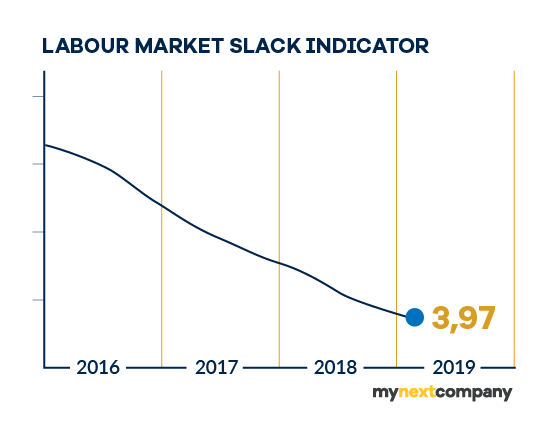 What’s more, the most sought-after positions are not necessarily in subject areas that young talent are most likely to choose to study at university.
The eternal gap between supply and demand
In Flanders, for example, the subject area that continues to attract the highest number of students is business, closely followed by law. There are many factors that students consider when choosing which subject to study, and one of these relates to economic concerns. While some choose professions which are in high demand, giving themselves a vast choice of offers in the future, many select professions that are generally associated with high-income jobs.
In the academic year 2018-2019, the most popular subject areas were economics (12034 applications) and law (12134 applications). However, the sectors with the highest job vacancy rate (the highest demand for experts in this domain) are information and communication (ICT) at 6.97%, construction at 5.97% and accommodation and food service activities at 5.6%.
Employer branding: just the beginning
So, what does this all mean? Employers are fighting over a small group of experts or, metaphorically speaking, fishing in the same (nearly empty) pond. Recruitment therefore becomes an art of attracting the best candidates, and not merely through the job description and list of responsibilities and skills, but also by presenting the value the job will offer the candidate (employee value proposition).
According to a LinkedIn study,
A staggering 49% of jobseekers state that not knowing what it’s really like to work at a company is an obstacle when it comes to choosing their next career move.
However, there is a solution to this: there are platforms like CompanyMatch, that focuses on presenting company culture, and MyNextCompany, which presents each company’s value to candidates through the eyes of an outsider each time they visit a new workplace. These platforms give applicants valuable insight into their prospective employer.
However, employer branding is only half of the story. A company might have a great brand, but be less than successful in conveying this to the right group. Even with a large advertising budget, it’s possible that an ad may only reach active candidates who are proactively searching for such information, for example by checking job boards. But what about passive candidates, who are too busy or lacking the motivation to search but who might be interested in changing job if the right offer came along?
The role of inbound recruitment
Inbound recruitment is a term borrowed from marketing and is the opposite of the traditional outbound recruitment approach.
Outbound recruitment (or classic recruitment, as described in our article “How Technology Enables Companies to Quickly Find the Best Talent”) starts by identifying the company’s need and then communicates this to the outside world so people know what kind of candidates the company is looking for.
Some examples of the tools used include:
- Mailshots with job opportunities, often using paid lists
- Advertising that focuses on jobs
- Headhunting
- Outbound sales calls
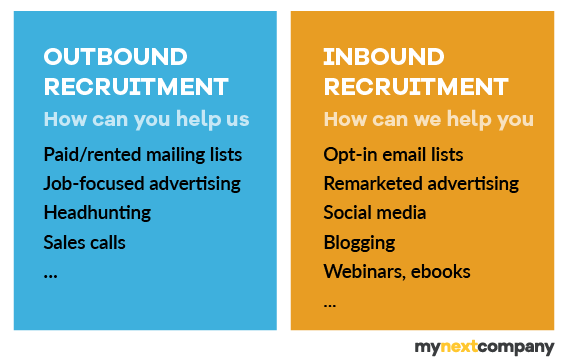
In contrast, inbound recruitment starts from the opposite end – that is, it identifies what the candidate is looking for and provides them with the information they seek. This allows candidates to find a company even before they’ve actively considered changing job. The idea behind this is to make candidates aware of the brand at an early stage so that they become loyal.
Some examples of the tools used include:
- Opt-in email lists
- Remarketed advertising
- Social media
- Blogging
- Webinars, eBooks
Inbound recruitment = easier access to talent
The main advantage of the inbound approach is that it accompanies candidates on their journey as they become closer to making the decision to change job. This allows companies to better predict when candidates will be most responsive to job offers.
Take a look at our best candidates with the most sought-after skills at the moment:
{{cta(‘8ae6af60-f254-45fa-87ef-08f2d09c1db9′,’justifycenter’)}}
By getting in touch with candidates early on, the recruiting company doesn’t wait until the last moment to look for candidates when the position opens. Instead, you can nurture your candidate funnel in order to proactively create a pool of available candidates that match your recruitment needs.
Depending on those needs, the content created can “catch” candidates with various skill sets, from specific location, or even interested in the exact industry you are hiring for. To be more specific, If a company X is active in the e-commerce sector, the content used for the inbound funnel could address certain challenges this sector is facing at the moment. This gives the recruiters tools to approach the recruitment campaign in a strategic, long-term way.
Spend on inbound to save on recruitment
As outlined in our article The Real Cost of Not Finding the Right Talent, recruitment is a costly business and the expenses can easily skyrocket when you cannot find the profiles you are looking for. What’s more, the company has to pay every time it needs to hire someone new.
On the other hand, setting up an inbound recruitment funnel is a one-time expense. Once you have implemented a strategy and created content, you can continue to attract candidates with it – all you need to do is make minor updates to the content. Or, easier still, you can call on a trusted partner for help, such as a recruitment agency that knows about inbound recruitment and can set up the funnel for you.
Read more in our article Why Is the Inbound Strategy Crucial for Your Recruitment Planning and What Is the ROI?
Conclusion
Although recruitment may be becoming an increasingly difficult task, it’s clear that there are plenty of solutions to make the job easier and to help you find the talent you seek without needing to invest huge amounts of time and money. Inbound recruitment and digital tools are now invaluable for HR managers, allowing you to harness the power of today’s technology in order to fulfil your staffing needs quicker and easier, all whilst keeping control of your budget.
Are you ready to discover the new way of recruiting? Smart Recruiting® is a method that we’ve introduced at MyNextCompany. It combines digital tools and inbound marketing strategy for fast, efficient, and qualitative recruitment. Download the white paper on Smart Recruiting and get ready to revolutionise your recruitment strategy today.
The post How Can Inbound Recruitment Provide You with the Talent Faster & Easier? appeared first on MyNextCompany.
]]>Deprecated: Using null as the key parameter for array_key_exists() is deprecated, use an empty string instead in /home/clearsou/mynextcompany.eu/wp-content/plugins/sitepress-multilingual-cms/vendor/wpml/fp/core/Obj.php on line 98
Deprecated: Using null as an array offset is deprecated, use an empty string instead in /home/clearsou/mynextcompany.eu/wp-includes/class-wp-block-type-registry.php on line 168
Deprecated: Using null as an array offset is deprecated, use an empty string instead in /home/clearsou/mynextcompany.eu/wp-includes/class-wp-block-type-registry.php on line 168
Deprecated: Using null as an array offset is deprecated, use an empty string instead in /home/clearsou/mynextcompany.eu/wp-includes/class-wp-block-type-registry.php on line 168
Deprecated: Using null as an array offset is deprecated, use an empty string instead in /home/clearsou/mynextcompany.eu/wp-includes/class-wp-block-type-registry.php on line 168
Deprecated: Using null as an array offset is deprecated, use an empty string instead in /home/clearsou/mynextcompany.eu/wp-includes/class-wp-block-type-registry.php on line 168
Deprecated: Using null as the key parameter for array_key_exists() is deprecated, use an empty string instead in /home/clearsou/mynextcompany.eu/wp-content/plugins/sitepress-multilingual-cms/vendor/wpml/fp/core/Obj.php on line 98
Deprecated: Using null as an array offset is deprecated, use an empty string instead in /home/clearsou/mynextcompany.eu/wp-includes/class-wp-block-type-registry.php on line 168
Deprecated: Using null as an array offset is deprecated, use an empty string instead in /home/clearsou/mynextcompany.eu/wp-includes/class-wp-block-type-registry.php on line 168
Deprecated: Using null as an array offset is deprecated, use an empty string instead in /home/clearsou/mynextcompany.eu/wp-includes/class-wp-block-type-registry.php on line 168
Deprecated: Using null as an array offset is deprecated, use an empty string instead in /home/clearsou/mynextcompany.eu/wp-includes/class-wp-block-type-registry.php on line 168
The post The Real Cost of Not Finding the Right Talent appeared first on MyNextCompany.
]]>Deprecated: Using null as an array offset is deprecated, use an empty string instead in /home/clearsou/mynextcompany.eu/wp-includes/class-wp-block-type-registry.php on line 168
Deprecated: Using null as the key parameter for array_key_exists() is deprecated, use an empty string instead in /home/clearsou/mynextcompany.eu/wp-content/plugins/sitepress-multilingual-cms/vendor/wpml/fp/core/Obj.php on line 98
Deprecated: Using null as an array offset is deprecated, use an empty string instead in /home/clearsou/mynextcompany.eu/wp-includes/class-wp-block-type-registry.php on line 168
Deprecated: Using null as an array offset is deprecated, use an empty string instead in /home/clearsou/mynextcompany.eu/wp-includes/class-wp-block-type-registry.php on line 168
Deprecated: Using null as an array offset is deprecated, use an empty string instead in /home/clearsou/mynextcompany.eu/wp-includes/class-wp-block-type-registry.php on line 168
Deprecated: Using null as an array offset is deprecated, use an empty string instead in /home/clearsou/mynextcompany.eu/wp-includes/class-wp-block-type-registry.php on line 168
Deprecated: Creation of dynamic property ET_Builder_Module_Helper_MultiViewOptions::$inherited_props is deprecated in /home/clearsou/mynextcompany.eu/wp-content/themes/Divi/includes/builder/module/helpers/MultiViewOptions.php on line 686
Deprecated: Creation of dynamic property ET_Builder_Module_Helper_MultiViewOptions::$inherited_props is deprecated in /home/clearsou/mynextcompany.eu/wp-content/themes/Divi/includes/builder/module/helpers/MultiViewOptions.php on line 686
Deprecated: Creation of dynamic property ET_Builder_Module_Helper_MultiViewOptions::$inherited_props is deprecated in /home/clearsou/mynextcompany.eu/wp-content/themes/Divi/includes/builder/module/helpers/MultiViewOptions.php on line 686

If you think it’s expensive to hire a professional, wait until you hire an amateur.” Red Adair
When recruiting new people for your company, it is essential to consider the cost of the new hires within your allocated budget. However, while we consistently consider the direct costs of new employees, namely their salary, social security contributions, bonuses and various other benefits, we tend to overlook the costs associated with finding (or, worse still, not finding) the talent needed.
How to evaluate the cost of recruitment
The indirect costs of recruitment can be pretty high. The costs cover outlining a profile and job description, selecting channels on which to post the ad, publishing the job ad, etc. However, a far higher cost is the salary time of other employees spent on recruitment: processing CVs, interviewing candidates and holding internal meetings to select the right candidate are just the beginning.
According to various studies, the cost of recruitment and integration is estimated at between 15% and 25% of the new employee’s gross annual salary. To get an idea of the real cost involved, calculate the hourly cost (gross salary + employer contributions + tax charges, etc.) of the employees involved multiplied by the time spent on each phase (drafting the ad, analysing applications, holding interviews, etc.) For the sake of this article and the example we outline later, we will assume an average cost of recruitment at 20% of the employee’s gross annual salary.
Calculate the actual cost of recruitment
HOURLY COST (gross salary + employer contributions + tax charges, etc.) of the employees involved x
TIME spent on each phase
Looking for a cheaper way of finding IT profiles? As developers are amongst the most rare profiles on the job market, we know that finding the one that will fit your needs is not easy. Luckily, help is on the way! Mynextcompany.io is the new Belgian platform that directly connects you with developers. Give it a try and see for yourself!
What happens when you don’t find the right people?
There are few things more frustrating for a business owner than having a long pipeline of orders and exciting growth plans, but then struggling to find the right people to make these a reality. Not being able to deliver on time and thus slowing down company growth are two of the main risks of insufficient staffing. This in turn might lead to a decline in the company’s reputation, or even a loss of clients and market share.
On top of the financial disadvantages of this situation, it’s also important to consider the human factor and the distress and difficulty caused to current team members. Existing employees often feel frustrated and obliged to do more work in order to compensate for the missing resources. The management is under pressure to deliver results. This creates additional stress and may cause an increased number of errors, which then leads to a drop in team morale, absenteeism, burnout and even loss of valuable employees.
What happens when you hire the wrong people?
The risks linked to understaffing are so high that some business owners may feel urged to take hasty recruitment decisions and potentially hire people who are not a good match for the role or organisation, or who do not have the necessary motivation and will leave within a few months.
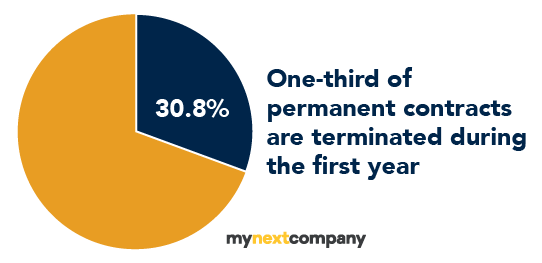 An Acerta survey found that 30,3% of permanent contracts in Belgium are terminated during the first year either by the employee or employer (26,3% for white-collar workers), but it is the company that has to bear the costs of terminating the contract and launching a new recruitment drive.
However, unmotivated or unskilled employees already bring losses when still working at the company. The operating loss is linked to the added value not received by the company, compared to the investment made. This cost can be estimated at at least 1.5 times the employee’s wage and may increase or even double depending on the company’s activity, the operating margin rate and the ratio of personnel costs to gross operating income.
The cost of unsuccessful hires
Let’s take a look at the following example. A new employee receives a gross monthly salary of €3,000. This amounts annually to €3,000 x 13.92 months: 12 months’ salary, and 1.92 months representing holiday pay = equalling €41,760 per year.
As mentioned earlier, the cost of recruitment and integration of the employee is estimated at between 15 and 25% of the employee’s annual salary. For this calculation, we will use the average of 20%, which amounts to €8,352.
Imagine that the contract is terminated after 2 months. During these 2 months, the employee received a gross salary of €6,000. Taking into account employers’ fees, the holiday pay and other social and fiscal charges, the cost to the employer is multiplied by at least 1.8, which amounts to €10,800.
To account for the operating loss due to the added value not received by the company, this amount can be multiplied again by 1.5, equalling €16,200.
The grand total cost of this unsuccessful hire totals €24,552 and will increase further due to the administrative costs of termination of the contract, which will vary from organisation to organisation.
EXAMPLE: Cost of an unsuccessful hire
Recruitment and onboarding: €8,352 +
(2-month salary cost to employer: €10,800 x
1.5 operating loss: €16.200) =Total cost: €24,552
This example allows us to estimate the cost of this particular unsuccessful hire at least €24,552. For companies experiencing a growth spurt, such as scaleups or larger companies branching out into new areas of activity and needing to hire many employees, this can represent a crushing loss.
Imagine a company that is very successful and needs to hire 50 new people this year. Statistically, out of these 50 people, 26.3% or 13 people will leave within the first year, according to the Acerta study we mentioned earlier. The cost of this failed recruitment will total €319,176 in this one year alone.
EXAMPLE: Potential annual loss (50 hires/year)
Loss incurred by one employee: €24,552 x
13 employees that will leave within 1 year =Total annual loss: €319,176
Conclusion
It’s therefore clear that unsuccessful recruitment can be at least as harmful to a company and its employees as no recruitment at all. In order to prevent such a serious situation and the associated financial losses, it’s vital to improve the overall recruitment process.
One way to achieve this is by using an external recruitment company. The cost of their services is considerably lower than the total of all internal costs, and generally includes a replacement guarantee if the person employed breaks the contract during the defined trial period.
It’s crucial to choose the right agency, especially if your business is experiencing intense growth and is likely to need to hire lots of people. The agency you choose needs to have the right long-term strategy to assist you with your recruitment needs. Our Smart Recruiting® method combines digital tools and marketing strategy for fast, efficient, and qualitative recruitment. Click on the button below for more information.
The post The Real Cost of Not Finding the Right Talent appeared first on MyNextCompany.
]]>Deprecated: Using null as the key parameter for array_key_exists() is deprecated, use an empty string instead in /home/clearsou/mynextcompany.eu/wp-content/plugins/sitepress-multilingual-cms/vendor/wpml/fp/core/Obj.php on line 98
Deprecated: Using null as an array offset is deprecated, use an empty string instead in /home/clearsou/mynextcompany.eu/wp-includes/class-wp-block-type-registry.php on line 168
Deprecated: Using null as an array offset is deprecated, use an empty string instead in /home/clearsou/mynextcompany.eu/wp-includes/class-wp-block-type-registry.php on line 168
Deprecated: Using null as an array offset is deprecated, use an empty string instead in /home/clearsou/mynextcompany.eu/wp-includes/class-wp-block-type-registry.php on line 168
Deprecated: Using null as an array offset is deprecated, use an empty string instead in /home/clearsou/mynextcompany.eu/wp-includes/class-wp-block-type-registry.php on line 168
Deprecated: Using null as an array offset is deprecated, use an empty string instead in /home/clearsou/mynextcompany.eu/wp-includes/class-wp-block-type-registry.php on line 168
Deprecated: Using null as the key parameter for array_key_exists() is deprecated, use an empty string instead in /home/clearsou/mynextcompany.eu/wp-content/plugins/sitepress-multilingual-cms/vendor/wpml/fp/core/Obj.php on line 98
Deprecated: Using null as an array offset is deprecated, use an empty string instead in /home/clearsou/mynextcompany.eu/wp-includes/class-wp-block-type-registry.php on line 168
Deprecated: Using null as an array offset is deprecated, use an empty string instead in /home/clearsou/mynextcompany.eu/wp-includes/class-wp-block-type-registry.php on line 168
Deprecated: Using null as an array offset is deprecated, use an empty string instead in /home/clearsou/mynextcompany.eu/wp-includes/class-wp-block-type-registry.php on line 168
Deprecated: Using null as an array offset is deprecated, use an empty string instead in /home/clearsou/mynextcompany.eu/wp-includes/class-wp-block-type-registry.php on line 168
The post Recruitment 3.0: How Did We End up Here? appeared first on MyNextCompany.
]]>Deprecated: Using null as an array offset is deprecated, use an empty string instead in /home/clearsou/mynextcompany.eu/wp-includes/class-wp-block-type-registry.php on line 168
Deprecated: Using null as the key parameter for array_key_exists() is deprecated, use an empty string instead in /home/clearsou/mynextcompany.eu/wp-content/plugins/sitepress-multilingual-cms/vendor/wpml/fp/core/Obj.php on line 98
Deprecated: Using null as an array offset is deprecated, use an empty string instead in /home/clearsou/mynextcompany.eu/wp-includes/class-wp-block-type-registry.php on line 168
Deprecated: Using null as an array offset is deprecated, use an empty string instead in /home/clearsou/mynextcompany.eu/wp-includes/class-wp-block-type-registry.php on line 168
Deprecated: Using null as an array offset is deprecated, use an empty string instead in /home/clearsou/mynextcompany.eu/wp-includes/class-wp-block-type-registry.php on line 168
Deprecated: Using null as an array offset is deprecated, use an empty string instead in /home/clearsou/mynextcompany.eu/wp-includes/class-wp-block-type-registry.php on line 168
Deprecated: Creation of dynamic property ET_Builder_Module_Helper_MultiViewOptions::$inherited_props is deprecated in /home/clearsou/mynextcompany.eu/wp-content/themes/Divi/includes/builder/module/helpers/MultiViewOptions.php on line 686
Deprecated: Creation of dynamic property ET_Builder_Module_Helper_MultiViewOptions::$inherited_props is deprecated in /home/clearsou/mynextcompany.eu/wp-content/themes/Divi/includes/builder/module/helpers/MultiViewOptions.php on line 686
Deprecated: Creation of dynamic property ET_Builder_Module_Helper_MultiViewOptions::$inherited_props is deprecated in /home/clearsou/mynextcompany.eu/wp-content/themes/Divi/includes/builder/module/helpers/MultiViewOptions.php on line 686

Finding the best talent means finding the best way to communicate with the person you want to hire. But this has changed significantly over the course of history, especially with the advent of the internet. From the “cold calling” method to “inbound marketing”, techniques and tools have evolved considerably in parallel with candidates’ mentality. But what will tomorrow’s recruitment look like? As Nicolas Machiavel rightly said, “To predict the future, you have to know the past”.
Let’s take a look back over the history of recruitment:
What we did in the past
Like other markets for the exchange of goods and services, the labour market is based on the principle of supply and demand. From the early 20th century until the 1950s, the relationship between labour supply and demand was direct, between employees and employers. It was at the beginning of the 1960s when an intermediary appeared: the headhunter.
However, it was only really in the 1980s when the profession of recruiter took on a real importance. Workforce management was being put in place and application databases were created.
The 1990s also brought their share of change, notably with the birth of e-recruitment (which has had a major impact on sourcing methods) and the dissemination of online job offers. In the same vein, the rise of social and professional networks since 2006 has completely disrupted recruitment methods.
What we’re doing now
Technology is now essential for successful recruitment. This makes it possible to better maintain relationships, personalise the service and anticipate candidates’ expectations. For example, recruiters can capture availability dates, define the type of contract, function and specialisations/technologies by launching targeted, efficient campaigns to collect this data. There is an increasing need for a better user experience for candidates, as illustrated by the rise of chatbots and artificial intelligence used to communicate with talent and guide them in their approach.
More specifically, technology offers a better user experience and makes it easier to approach and retain digital profiles that are in extremely short supply.
Watch this video in which Alban Gaffori explains his vision of recruitment 3.0.
What we’re moving towards
The future of recruitment therefore depends irrevocably on technology. Technology will play a key role both in the distribution of advertisements and the various innovations on the market as well as through promising start-ups, which are constantly challenging recruitment methods and codes.
It is very likely that collaborative web platforms will emerge where qualified people will take on the role of recruiter. We can also think further by imagining, for example, applications dedicated to recruitment, which will make it possible to save a considerable amount of time. By bypassing the services of a traditional agency, the contact between candidate and employer is direct and linear. This disruption is reminiscent of the work of Uber or AirBnB.
Can the profession of recruiter be permanently replaced by a digital interface? IT, like AI, can help, support or even facilitate the recruitment process, but certainly not replace it. The human factor is far too important in this sector and cannot be erased. However, it will certainly evolve and operate differently in the coming years, in line with the needs of talent and employers.
The new era of recruitment has already begun. In Belgium, a new platform has been created to put companies in direct contact with IT developers: mynextcompany.io. But like Uber and AirBnb, this type of model has its limitations: due to a different price model, they do not offer a complete package as you might find in a hotel night that includes several services such as breakfast for example. It is therefore an economical, fast and efficient alternative, but one that will not suit all companies. Depending on its needs and budget, companies will find their happiness either in a more “classic” and “tailor-made” solution or in a more “direct” and “fast” solution.
The post Recruitment 3.0: How Did We End up Here? appeared first on MyNextCompany.
]]>